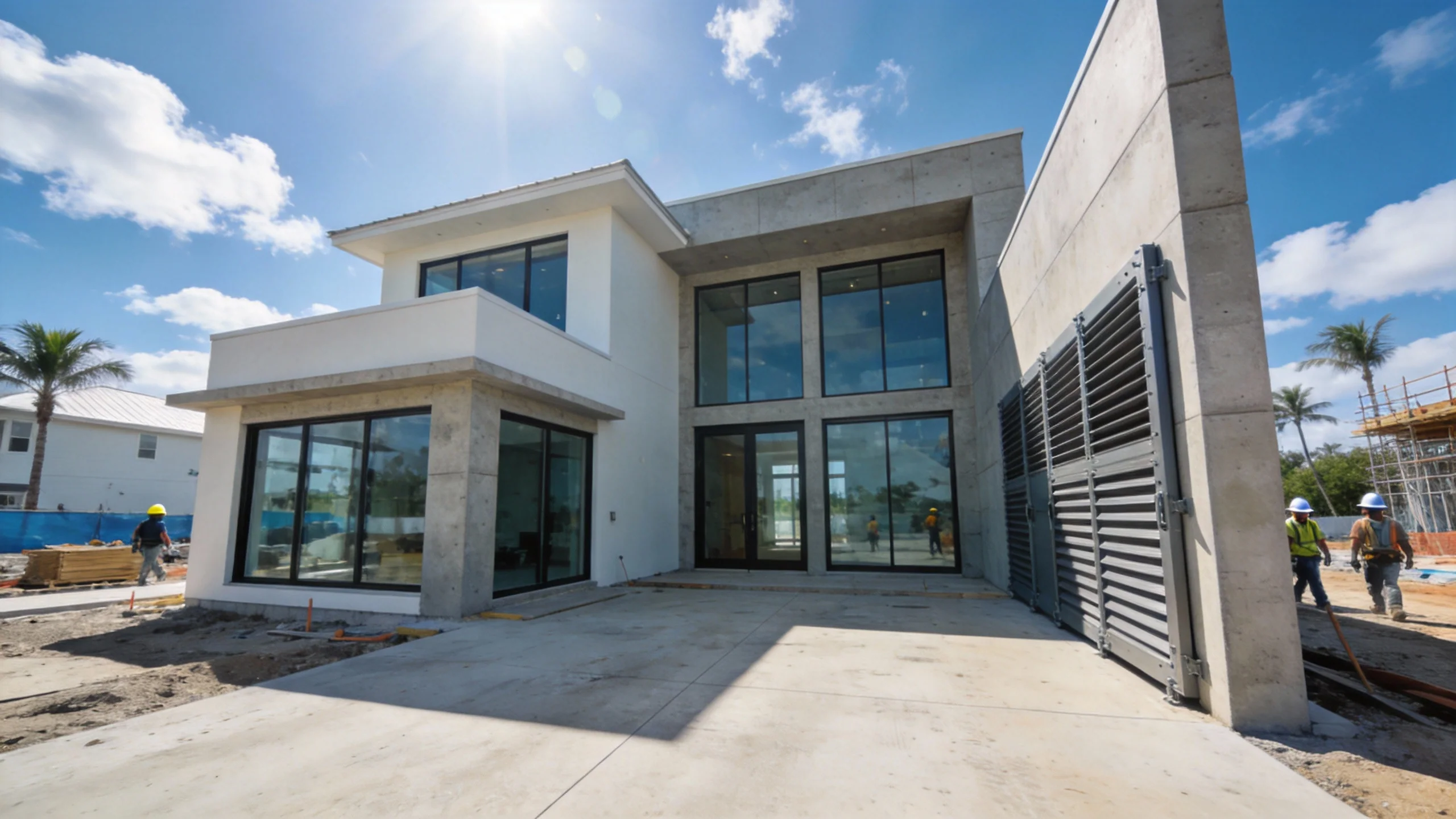

The most common air conditioning complaint we hear in Miami is not that the house is warm. It is that the house is cold and still feels damp — windows sweating, doors sticking, a musty smell in the closets. That is almost always a design problem, not an equipment problem, and it usually starts with a system that is too big.
Sensible load and latent load
An air conditioner does two jobs at once. It removes sensible heat — the temperature you feel — and latent heat, the energy held in water vapour, which it does by condensing moisture on a cold coil and draining it away. In a dry climate the sensible load dominates. In Miami, latent load can be a third or more of the total.
Removing moisture requires runtime. Air has to pass over the coil long enough and often enough for condensation to form and drain. A correctly sized system runs long, steady cycles and pulls a lot of water out of the house. An oversized system satisfies the thermostat in a few minutes, shuts off before the coil is properly wet, and leaves the moisture behind — sometimes even re-evaporating what it just condensed back into the airstream at the start of the next cycle.
This is the central counter-intuition of hot-humid HVAC design: a bigger unit makes the house feel worse. Cold and clammy at 74 °F is a comfort failure, and it is also a mould risk.
Target indoor relative humidity is roughly 45–55 %. Above about 60 %, mould growth becomes a real possibility on cool surfaces and in closed spaces, regardless of how cold the air is.
Sizing: Manual J, not rules of thumb
The old rule — one ton per 500 or 600 square feet — was written for a housing stock with single glazing, minimal insulation and enormous air leakage. Applied to a modern or renovated house with impact glass and a sealed envelope, it produces equipment that is 40–60 % oversized.
A proper Manual J load calculation accounts for orientation, glazing area, glass performance, shading, insulation levels, infiltration rate, ceiling height, occupancy and internal gains. It produces separate sensible and latent numbers, and in South Florida the latent number is what tells you whether the equipment can actually dehumidify.
| Design input | Why it matters here |
|---|---|
| Window area and orientation | West glazing drives afternoon peak load disproportionately |
| Glass SHGC | Impact glass with a low-E coating can cut solar gain substantially |
| Infiltration rate | Untreated outdoor air is the largest single source of latent load |
| Duct location | Ducts in a vented attic operate in 130 °F air |
| Occupancy | People are a latent load — roughly 200 BTU/h each in water vapour |
Where a load lands between two nominal equipment sizes, the correct move in a humid climate is generally to take the smaller unit and design the distribution well, or better still to specify variable-capacity equipment that can modulate down and run continuously at part load.
Ducts: the system nobody looks at
Duct leakage in a vented attic is uniquely punishing. Supply leakage dumps conditioned air where it does nothing; return leakage actively pulls 130 °F, high-humidity attic air into the system and pressurises the house with it. A system with 20 % duct leakage in an attic is not an inefficient system — it is a dehumidification failure.
What good ductwork looks like
- Sealed with mastic at every joint and connection, not tape alone.
- Sized by Manual D so each branch delivers its design airflow at the design static pressure.
- Short and straight. Flexible duct is acceptable, sagging serpentine flexible duct is not — every unnecessary bend costs static pressure.
- Pulled taut and supported at the manufacturer's spacing, without compression at supports.
- Insulated to the current energy code R-value for its location.
- Adequate return path. Closed bedroom doors without transfer grilles or jump ducts pressurise the room and depressurise the rest of the house, dragging in outdoor air.
- Pressure-tested and documented — Florida's energy code requires duct leakage testing on new and substantially altered systems.
Choosing equipment
| System | Best for | Watch out for |
|---|---|---|
| Single-stage split | Budget replacements, small homes | Poor humidity control if oversized at all |
| Two-stage split | Most homes; good value | Needs correct low-stage airflow setup |
| Variable-capacity (inverter) | Best comfort and dehumidification | Higher cost; needs a competent installer |
| Ducted mini-split | Additions, zoning, difficult layouts | Condensate management and filter access |
| VRF | Multi-zone residential and light commercial | Requires trained service support |
| Whole-house dehumidifier | Very tight or low-load homes | Needs its own duct and drain design |
Efficiency ratings are worth understanding but not worth over-optimising. Moving from a very old system to a current-efficiency unit is a large improvement; moving between two high-efficiency tiers is a much smaller one, and the difference is easily erased by leaky ducts or an oversized selection. Spend the marginal dollar on distribution and commissioning before you spend it on the rating badge.
Where a dehumidifier makes sense
In a well-sealed home with a low sensible load — a shaded, insulated house with good glass — the air conditioner may satisfy temperature long before it has removed enough moisture. That is exactly the case for a dedicated whole-house dehumidifier, which handles latent load independently and lets the cooling equipment be sized correctly for the sensible load.
Ventilation, filtration and pressure
Tighter modern envelopes need deliberate ventilation. Uncontrolled infiltration is not ventilation; it is just leakage that happens to bring humidity with it.
- Controlled outdoor air introduced through a dedicated, dampered, filtered duct with a controller that limits how much comes in and when.
- Balanced exhaust. Kitchen and bath exhaust must have a make-up path, or the house simply pulls replacement air through the walls and attic.
- Filtration. MERV 11–13 is a good balance in most residential systems, provided the filter area is large enough not to raise static pressure — a deep-pleat media filter rather than a thin one-inch panel.
- Keep the house slightly positive or neutral. A negatively pressurised building in Miami pulls hot, humid outdoor air through every crack in the envelope.
Commissioning: the step that gets skipped
A correctly specified system that is never commissioned performs like an incorrectly specified one. Before anyone signs off, the following should be measured and written down:
- Refrigerant charge verified by superheat or subcooling, not by gauge pressure alone.
- Total external static pressure measured and compared to the equipment's design value.
- Airflow per ton verified — and set toward the lower end of the acceptable range in a humid climate to improve moisture removal.
- Room-by-room airflow balanced against the Manual D design.
- Duct leakage test result recorded.
- Condensate slope, trap, secondary pan and float switch verified.
- Thermostat configuration — fan set to auto, not on. Continuous fan re-evaporates condensate off the coil and back into the house between cycles.
Ask for the commissioning numbers in writing. A contractor who measures static pressure and airflow as a matter of routine is a different proposition from one who sets the thermostat and drives away.
Upgrades ranked by value
- Seal the ducts. Highest return of anything on this list, especially in attic systems.
- Fix the return path. Transfer grilles or jump ducts for every closed room.
- Correct the airflow setup. Free, if the installer measures.
- Add attic insulation and air-seal the ceiling plane. Reduces both load and duct penalty.
- Set the fan to auto and use a thermostat with humidity control.
- Right-size the equipment at replacement time, based on a real load calculation.
- Add a dedicated dehumidifier if humidity remains above 55 % after the above.
- Move the ducts inside conditioned space during a major renovation.
Notice that equipment replacement sits sixth. In a hot-humid climate, most comfort complaints are distribution and control problems wearing an equipment costume.