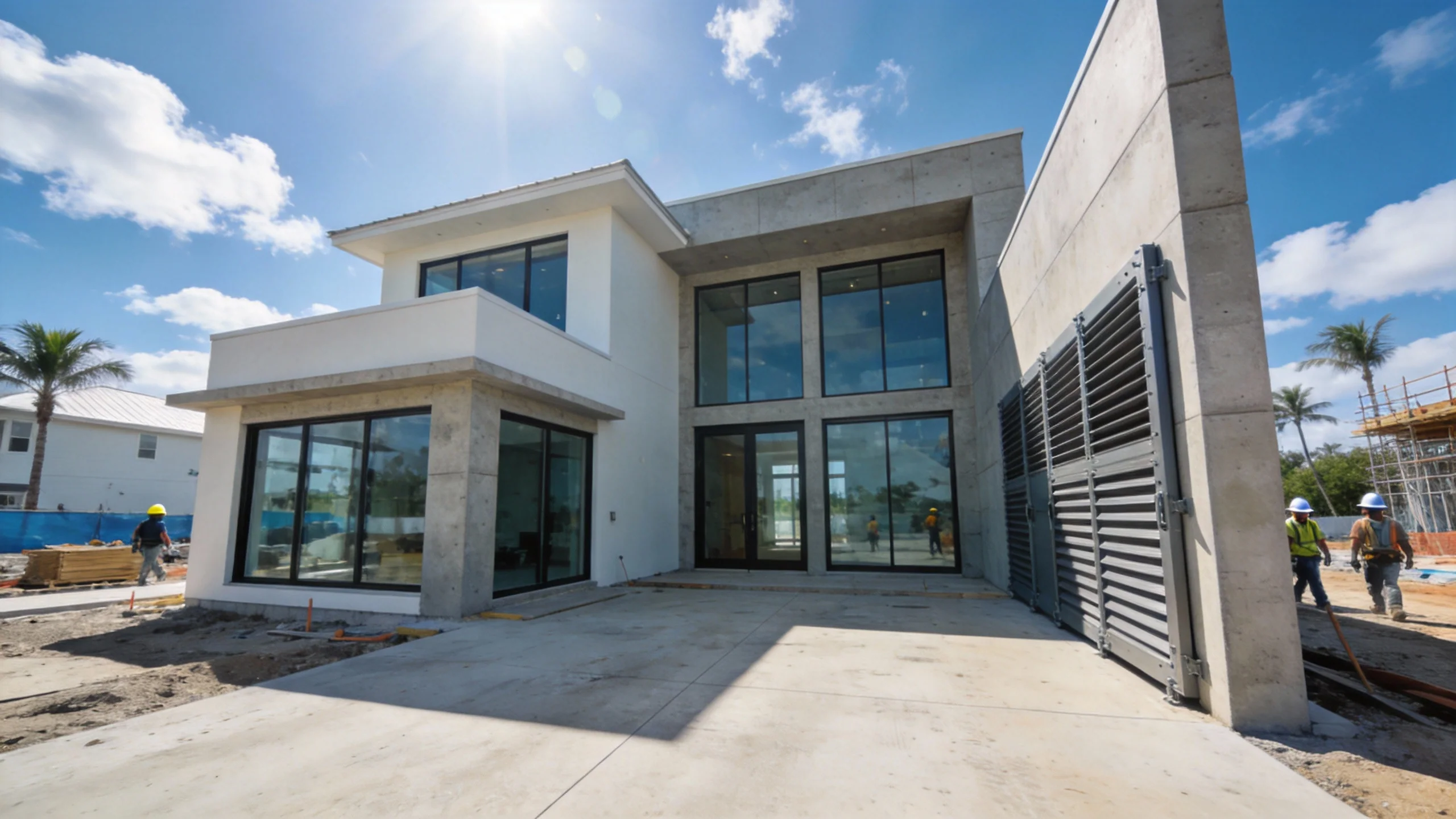

Nobody in Miami fails a project because they could not build it. They fail because the permit sat in review for four months while a supplier's product approval expired. This guide walks through the permit process the way it actually runs — the sequence, the documents, the realistic timelines, and the specific mistakes that cost the most time.
Who issues your permit
The first thing to establish is which building department has jurisdiction over your property, because the answer changes the timeline, the fee schedule and the submittal portal. Miami-Dade County is not a single permitting authority — it is a county department plus thirty-odd municipal departments, each with its own review queue.
- Municipal building department — if the property sits inside an incorporated city (City of Miami, Miami Beach, Coral Gables, Hialeah, Doral, Homestead and so on), that city issues the building permit.
- Miami-Dade County — unincorporated areas are permitted directly by the county's Department of Regulatory and Economic Resources.
- County product approval — regardless of jurisdiction, exterior products in the High-Velocity Hurricane Zone need either a Miami-Dade Notice of Acceptance (NOA) or a Florida Product Approval, and the specific number goes on the plans.
- Other agencies — DERM for environmental and septic matters, the Health Department for wells, WASD for water and sewer connections, and the fire department for anything commercial.
Where owners lose the most time is assuming that a permit from the city covers the county agencies too. It does not. A pool permit that clears the city can still sit for weeks waiting on a DERM sign-off nobody applied for.
What needs a permit — and what does not
The reflexive answer in Florida is "assume yes." Structural, electrical, plumbing, mechanical and roofing work all require permits, and so do many things owners assume are cosmetic.
| Work | Permit | Notes |
|---|---|---|
| Interior paint, flooring, cabinet refacing | Not usually required | No structural, plumbing or electrical change |
| Window or door replacement | Building permit | Product approval number required on the application |
| Water heater replacement | Plumbing permit | Includes the relief line and drain pan |
| A/C changeout | Mechanical permit | Load calculation may be requested |
| Removing an interior wall | Building permit | Engineer's letter or beam design if load-bearing |
| Re-roof | Roofing permit | Deck re-nailing and secondary water barrier inspected |
| Fence, shed, driveway | Building permit | Zoning setbacks reviewed |
| Kitchen or bath remodel | Building + trade permits | Usually three or four separate trade permits |
The cost of skipping a permit is not the fine. It is the after-the-fact permit — double fees, exposed work, and an inspector who is entitled to ask you to open up finished walls. It also surfaces at the worst possible moment: during a sale, when the title company runs an open-permit search.
What a complete submittal package contains
Plan reviewers reject incomplete packages faster than they reject bad design. A residential remodel package for a Miami jurisdiction typically includes:
- The permit application, signed and notarised by the owner and the licensed contractor.
- A recorded Notice of Commencement for work over the statutory threshold.
- Sealed drawings — floor plan, demolition plan, structural details, MEP plans as applicable.
- Florida Energy Code compliance forms for envelope or mechanical work.
- Product approval documentation (NOA numbers) for every exterior opening and roofing component.
- A current survey for anything affecting the footprint, setbacks or impervious area.
- Structural calculations where the design changes load paths.
- Proof of contractor licence, insurance and workers' compensation.
Two documents cause more delays than the rest combined. The first is the Notice of Commencement, which must be recorded and posted before the first inspection — not before the permit, before the inspection. The second is product approval: a reviewer will not accept "impact window, white" as a specification. They want the NOA number, the approved configuration, and the design pressure that matches the opening.
Realistic timelines, stage by stage
Published targets and lived experience are different things. The ranges below reflect what we see across Miami-Dade jurisdictions in ordinary conditions, not immediately after a storm event when queues triple.
| Stage | Typical duration | What drives it |
|---|---|---|
| Pre-application research | 2–5 days | Folio search, open permits, zoning district |
| Drawing preparation | 1–4 weeks | Scope complexity, engineering involvement |
| Intake & fee assessment | 1–5 days | Portal queue, completeness screening |
| First plan review cycle | 2–5 weeks | Number of disciplines reviewing in parallel |
| Comment response & re-submittal | 1–3 weeks | How fast your design team turns comments |
| Second review cycle | 1–3 weeks | Usually shorter than the first |
| Issuance | 1–5 days | Fee payment and printing |
An interior remodel with no structural work commonly moves from filing to issued permit in three to six weeks. Add structural changes and it becomes eight to twelve. Add a change of use, a variance, or a historic-district review and you should plan in months, not weeks.
The single largest variable is not the building department. It is how quickly the applicant answers plan-review comments. We have seen the same scope issued in 19 days and in 7 months, on the strength of that one factor.
Plan review comments and how to kill them fast
Almost every package gets comments on the first cycle. That is normal and not a sign of a problem. What matters is the turnaround.
Comments arrive by discipline — structural, plumbing, mechanical, electrical, zoning, energy — and each reviewer works independently. A common failure is answering the structural comments this week, the mechanical comments next week, and re-submitting twice. Every re-submittal puts you back in the queue. Collect all comments, resolve all of them, submit once.
The five most common comments in Miami-Dade
- Missing or expired product approval. NOAs have expiry dates; a number that was valid when the drawings were produced may not be valid at review.
- Energy code forms incomplete. Unsigned or not matching the mechanical equipment shown on the plans.
- Structural details not sealed. A detail copied into the set without the engineer's seal and signature.
- Zoning inconsistency. Setbacks, lot coverage or impervious area on the plan not matching the survey.
- Scope mismatch. The application describes less work than the drawings show — usually an attempt to reduce fees that costs weeks instead.
Inspections: sequence matters more than speed
Once the permit is issued the clock changes character. Permits expire if no inspection is requested and passed within a set period — in most Florida jurisdictions 180 days from issuance and again from each passed inspection. Keeping a permit alive is as simple as passing one inspection within that window.
The sequence for a typical remodel runs:
- Demolition — where a separate demo permit was issued.
- Rough plumbing, mechanical and electrical — before insulation or drywall, with systems under test pressure where required.
- Framing / structural — after rough-ins are in place so penetrations are visible.
- Insulation and energy — where the envelope is altered.
- Drywall — screw pattern and fire-rated assemblies.
- Final trade inspections — plumbing, mechanical, electrical.
- Final building — followed by the Certificate of Completion or Occupancy.
Closing the permit — the step everyone forgets
A passed final inspection is not the same as a closed permit. The permit closes when the jurisdiction records the final and issues the Certificate of Completion (for work that does not change occupancy) or the Certificate of Occupancy (for new buildings and changes of use).
Open permits are the single most common cause of delayed real-estate closings in Miami-Dade. They show up in the title search years later, and resolving one retroactively means finding the original contractor, or applying as owner-builder to close somebody else's work, or in the worst case re-permitting and exposing finished construction for inspection.
Before you release final payment on any project, ask for three things: the permit number, a printout showing all inspections passed, and the certificate. If your contractor cannot produce all three, the job is not finished.
What permits cost
Permit fees in Miami-Dade are generally calculated from the declared value of the work, with minimum fees and a series of surcharges added on top. As a planning figure, budget roughly 1.5 % to 3 % of construction value for a residential project, plus separate trade permit fees.
| Cost component | Typical share |
|---|---|
| Building permit fee (value-based) | ~60 % |
| Trade permits (plumbing, mechanical, electrical) | ~20 % |
| Plan review and technology surcharges | ~10 % |
| State surcharges and impact-related fees | ~10 % |
Two cost notes worth knowing. Declaring a value below the real construction cost to save fees is a false economy — reviewers compare declared value to scope and adjust it, and a mismatch invites scrutiny of the whole application. And after-the-fact permits for unpermitted work typically carry a penalty multiplier on the base fee, on top of whatever it costs to expose the work.
A pre-application checklist
Run this list before you file. It takes an afternoon and routinely saves a month.
- Folio number confirmed and permit history pulled.
- No open or expired permits on the property.
- Jurisdiction confirmed — city versus unincorporated county.
- Zoning district, setbacks and lot coverage verified against a current survey.
- Flood zone and base flood elevation checked if the work affects the ground floor.
- HOA or condominium association approval obtained in writing.
- All exterior products selected, with current NOA numbers listed.
- Drawings sealed by a Florida-registered architect or engineer where required.
- Contractor licence, general liability and workers' compensation current.
- Notice of Commencement prepared for recording.
If you would rather not run it yourself, that is essentially our permitting service: we do this research, file the package, answer the comments and close the permit — and we do it every week, in every jurisdiction in the county.